NRP 9th Edition · Algorithm guide
The NRP algorithm, step by step (9th Edition)
The NRP algorithm is a short decision path. You assess the baby, act, check the heart rate, and escalate only when the heart rate says to. This is the 9th Edition path in order, with the number that triggers each step.
Free demo No account required English & Spanish
The algorithm, step by step
Most newborns need no help. About 85% of term babies start breathing within 30 seconds of birth, and another 10% respond to drying and stimulation. When a baby does need help, the cause is usually respiratory failure, so ventilating the lungs is the most important step. Chest compressions and epinephrine come in only when the heart rate stays below 60 bpm despite effective ventilation.
The steps below follow the 9th Edition flowchart from the pre-birth questions to post-resuscitation care. Each one ends with a link to the article that covers it in depth.
-
Lesson 2
Before the birth: ask, brief, check
Ask the obstetric provider four things: the expected gestational age, whether the amniotic fluid is clear, any additional risk factors, and the umbilical cord management plan.
- Every birth needs at least 1 qualified person whose only job is the newborn. If any risk factor is present, at least 2.
- If advanced resuscitation is likely, the full team should be in the room at the birth, not on call.
- Hold a pre-resuscitation briefing and run the equipment check before the baby arrives.
Read more: The 4 NRP pre-birth questions
-
Lesson 3
At birth: routine care or the radiant warmer?
Is the baby term? Is the muscle tone good? Is the baby breathing or crying?
- All yesSkin to skin with the parent, routine care, normal temperature and ongoing evaluation.
- Any noAt the time of cord clamping, bring the baby to the radiant warmer.
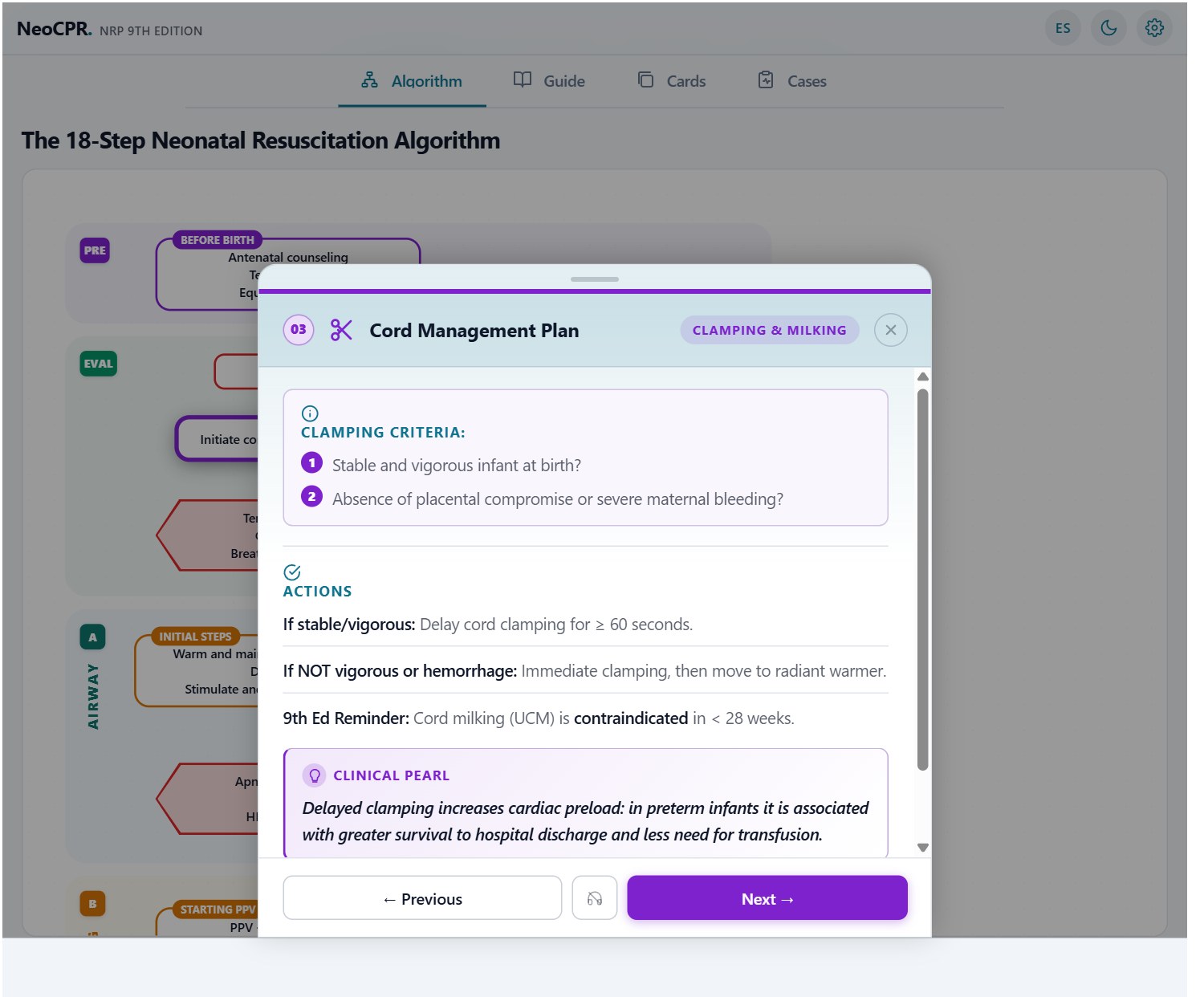
Start the cord management plan at birth. For most babies who don't need immediate resuscitation, clamping waits at least 60 seconds. Cord management should never delay ventilation for a baby who is still apneic or has a heart rate below 100 bpm by 60 seconds.
Read more: Umbilical cord management
-
Lesson 3
At the warmer: initial steps
Warm and dry the baby, position the head and neck to open the airway, and stimulate if needed.
Routine suctioning is not recommended. If secretions need clearing, wipe the mouth and nose with a cloth, and suction gently only if you're worried about obstruction.
Read more: Meconium-stained fluid in the 9th Edition
-
Lessons 3 and 4
Check breathing and heart rate
Apnea or gasping? Heart rate below 100 bpm?
- YesStart ventilation. Assisted ventilation is indicated by 1 minute after birth and should begin within that first minute.
- No, but laboredIf breathing is labored or cyanosis persists: pulse oximeter, oxygen if needed, and consider CPAP.
- NoIf breathing is comfortable and the heart rate is at least 100 bpm, continue routine care.
Read more: CPAP vs PPV: the signs that decide and preductal SpO₂ targets
-
Lesson 4
Ventilate
Start with a face mask or a laryngeal mask. Give 30 to 60 breaths per minute with an initial peak inflation pressure of 25 cm H₂O (25 to 30 for term babies and preterm babies of 32 weeks or more, 20 to 25 under 32 weeks) and PEEP of 5 cm H₂O if your device provides it.
The best sign that ventilation is working is a rising heart rate.
- Start FiO₂ at 21% from 35 weeks, at 21% to 30% from 32 to 34 weeks, and consider 30% or higher under 32 weeks.
- Put a pulse oximeter on the right hand or wrist and adjust FiO₂ to the minute-specific targets.
- Consider a cardiac monitor.
Read more: NRP PPV settings and the PPV settings calculator
-
Lesson 4
Heart rate still below 100, or the chest is not moving
If the heart rate isn't rising within 15 to 30 seconds and the chest isn't moving, work through the ventilation corrective steps, checking for chest movement after each one: Mask adjustment, Reposition the head and neck, Suction the mouth and nose, Open the mouth, Pressure increase, Alternative airway.
- Consider intubation or a laryngeal mask.
- Use a cardiac monitor.
- If mask ventilation or CPAP continues for more than several minutes, insert an orogastric tube.
Read more: MR SOPA explained, laryngeal mask airway and ETT size and depth
-
Lessons 4, 5 and 6
Heart rate below 60: compressions
Heart rate below 60 bpm despite at least 30 seconds of ventilation that moves the chest?
- Insert an alternative airway if you haven't already, and ventilate through it for 30 seconds. An endotracheal tube is strongly recommended before compressions. A correctly placed laryngeal mask is reasonable if intubation fails or isn't feasible.
- If the heart rate is still below 60 bpm, raise FiO₂ to 100% and start compressions.
- Give 3 compressions to 1 breath: 90 compressions and 30 breaths per minute.
- Put your thumbs on the sternum just below the nipple line and press about one third of the front-to-back diameter of the chest. Once the airway is secure, move to the head of the bed.
- Ask for help and get emergency vascular access ready (UVC or IO).
- After 60 seconds, pause briefly and check the heart rate. A cardiac monitor is the preferred method. At 60 bpm or above, stop compressions and resume ventilation at 30 to 60 breaths per minute.
Read more: Neonatal chest compressions and the 3:1 ratio and UVC vs IO access
-
Lesson 7
Still below 60: epinephrine
Heart rate below 60 bpm after 60 seconds of coordinated compressions and ventilation with 100% oxygen?
- Give epinephrine IV (umbilical vein catheter) or IO. Use only the dilute 0.1 mg/mL concentration.
- The suggested dose is 0.02 mg/kg (acceptable range 0.01 to 0.03), repeated every 3 to 5 minutes if needed.
- An endotracheal dose (0.1 mg/kg) may be considered only while vascular access is being established. Don't delay access.
- If the heart rate stays below 60 bpm, consider hypovolemia and pneumothorax. A 10 mL/kg volume expander is indicated for signs of shock or a history of acute blood loss.
Read more: NRP 9th Edition epinephrine: dose, route, timing, the epinephrine dose calculator and volume expanders
-
Lesson 9
After the resuscitation
A baby who needed help stays under close observation with frequent assessment, and some need a blood gas and glucose and electrolyte checks. Every birth unit needs a way to identify babies who may qualify for therapeutic hypothermia, because treatment has to start promptly. Avoid overheating during and after resuscitation.
Talk with the family, then hold a team debriefing.
Read more: Therapeutic hypothermia and HIE
Want to tap through it instead of reading it? The interactive algorithm in the NeoCPR demo opens each step with what to assess and what to do, with audio narration. The demo covers the flowchart up to Initial steps; the evaluation of heart rate and breathing onward is in the full module. No account needed.
Open the interactive algorithmThe heart rate thresholds in one table
Every branch depends on the heart rate and on how long you have been ventilating effectively.
| Heart rate | What you have done | Next step |
|---|---|---|
| Below 100 bpm, or apnea or gasping | Initial steps, by 1 minute of age | Start positive-pressure ventilation |
| Below 100 bpm and the chest is not moving | 15 to 30 seconds of ventilation | Ventilation corrective steps (MR SOPA) |
| Below 60 bpm | At least 30 seconds of ventilation that moves the chest | Alternative airway if not in place, then 100% oxygen and chest compressions |
| Below 60 bpm | 60 seconds of coordinated compressions and ventilation | Epinephrine IV or IO. Consider hypovolemia and pneumothorax. |
| 60 bpm or above | During compressions | Stop compressions and resume ventilation at 30 to 60 breaths per minute |
Where the algorithm trips people up
- Starting compressions too early. Compressions aren't indicated until ventilation is inflating the lungs. Check for chest movement first, and run the corrective steps if it's missing.
- Reaching for epinephrine before the sequence is done. It is indicated after at least 30 seconds of effective ventilation and another 60 seconds of coordinated compressions with 100% oxygen, not before ventilation inflates the lungs.
- Trusting a poor heart rate reading. An inaccurate heart rate can lead to unnecessary compressions. If the risk factors suggest a complex resuscitation, place cardiac monitor leads once assisted ventilation starts.
- Suctioning by reflex. Routine oral, nasal, oropharyngeal or endotracheal suctioning is not recommended.
- Reading "no risk factors" as "no resuscitation." Some babies with no apparent risk factors still need it, so every birth needs a qualified person and working equipment.
- Missing the cause after intubation. If the baby worsens after intubation, think DOPE: displaced tube, obstructed tube, pneumothorax, equipment failure.
More of these are in common NRP exam mistakes, and NRP 8th vs 9th Edition: what changed covers what is different from the older flowchart.
Questions about the NRP algorithm
What is the NRP algorithm?
When do you start chest compressions in NRP?
When is epinephrine given in neonatal resuscitation?
What is the compression to ventilation ratio in NRP?
What are the first questions after birth?
Can I practice the algorithm interactively?
Does this page replace the NRP course?
This page summarizes the NRP 9th Edition textbook for study. It does not replace your NRP course or your hospital's protocols. PediaSuite is independent and is not affiliated with the AAP or AHA.
Keep studying
NRP study guide
What each of Lessons 1 to 11 covers, plus one table of the numbers worth memorizing.
Open the study guide →NRP flashcards
Twenty sample cards written from the textbook, with the lesson listed under each answer.
Try the cards →NRP practice cases
Three worked cases with the decision points and answers.
Work a case →NRP practice questions
Scenario-based exam questions with tutor and timed exam modes.
Take the practice exam →Tap through the whole algorithm in the free demo.
It is the real NeoCPR app with some content locked. No account or credit card. The full module is a one-time $29 with no subscription.
References
- American Academy of Pediatrics, American Heart Association. Textbook of Neonatal Resuscitation. 9th ed. Itasca, IL: American Academy of Pediatrics; 2025. Lesson 1: Foundations of Neonatal Resuscitation; Lesson 2: Anticipating and Preparing for Resuscitation; Lesson 3: Initial Steps of Newborn Care; Lesson 4: Ventilation; Lesson 5: Endotracheal Intubation; Lesson 6: Chest Compressions; Lesson 7: Medications; Lesson 9: Post-Resuscitation Care.
- Lee HC, Strand ML, Finan E, et al. Part 5: Neonatal Resuscitation: 2025 American Heart Association and American Academy of Pediatrics Guidelines for Cardiopulmonary Resuscitation and Emergency Cardiovascular Care. Circulation. 2025;152(16 Suppl 2):S385–S423. doi:10.1161/CIR.0000000000001367