NRP 9th Edition · 20 sample cards
NRP flashcards for the 9th Edition
Twenty free sample cards for the NRP 9th Edition, written from the textbook. Tap a question to see the answer, then try the flashcards in the free demo.
Free demo No account required English & Spanish
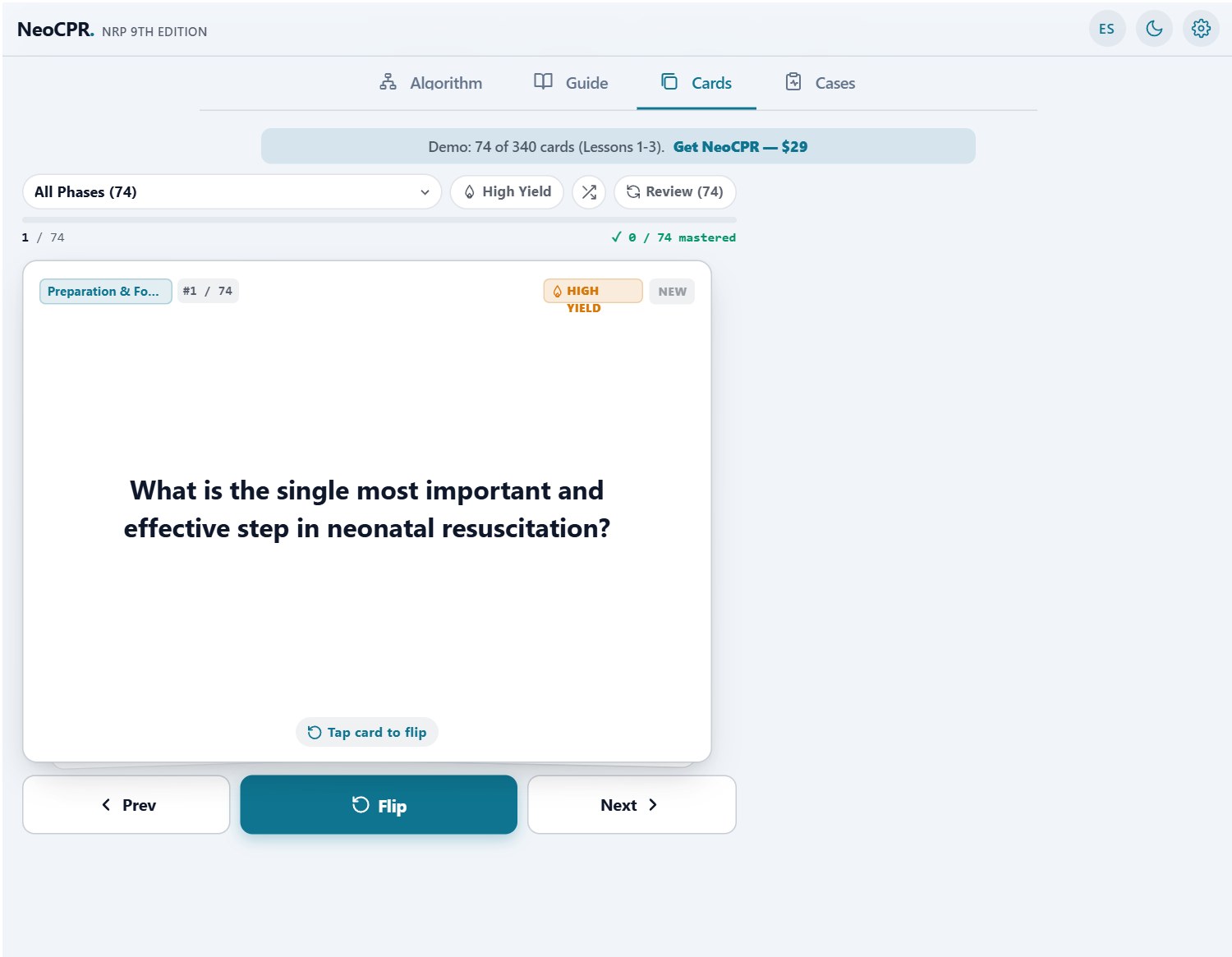
Twenty sample cards
Much of NRP comes down to exact thresholds: which heart rate triggers which step, how many seconds you wait before escalating, which dose you draw up. Flashcards are a good fit for that kind of recall.
Each answer below names the textbook lesson it comes from. Tap a question to reveal the answer.
What are the 4 pre-birth questions?
What is the expected gestational age? Is the amniotic fluid clear? Are there any additional risk factors? What is the umbilical cord management plan?
Which 3 questions decide between routine care and the radiant warmer?
Is the baby term? Is the muscle tone good? Is the baby breathing or crying?
If any answer is no at the time of cord clamping, bring the baby to the radiant warmer. If all three are yes, the baby can stay skin to skin with the parent.
When is assisted ventilation indicated?
When the baby is not breathing, is gasping, or has a heart rate below 100 bpm by 1 minute after birth. Start ventilation within 1 minute of birth.
How long should cord clamping be deferred if the baby doesn't need immediate resuscitation?
For most babies, at least 60 seconds. Cord management should not delay ventilation for a baby who is still apneic or has a heart rate below 100 bpm by 60 seconds after birth.
Is routine suctioning recommended for meconium-stained fluid?
No. Routine laryngoscopy, with or without intubation for tracheal suction, is not suggested. Intubation and tracheal suction are recommended if the baby needs assisted ventilation and there is concern for airway obstruction.
What is the most important and effective step in neonatal resuscitation?
Ventilating the baby's lungs. Respiratory failure is the most common reason a newborn needs resuscitation.
What are the initial PPV settings?
Rate: 30 to 60 breaths per minute. Peak inflation pressure: 25 cm H₂O (25 to 30 for term babies and preterm babies of 32 weeks or more, 20 to 25 for preterm babies under 32 weeks). PEEP: 5 cm H₂O, if used.
What is the best sign that ventilation is working?
A rising heart rate.
What are the ventilation corrective steps, and when do you start them?
MR SOPA: Mask adjustment, Reposition the head and neck, Suction the mouth and nose, Open the mouth, Pressure increase, Alternative airway.
Start them if the heart rate isn't rising within 15 to 30 seconds of ventilation and you don't see chest movement.
What initial FiO₂ do you use, by gestational age?
35 weeks or more: 21%. 32 to 34 weeks: 21% to 30%. Under 32 weeks: 30% or higher may be considered.
Then adjust to the minute-specific SpO₂ targets using a pre-ductal pulse oximeter.
When do you start chest compressions?
When the heart rate stays below 60 bpm despite at least 30 seconds of ventilation that inflates the lungs (the chest moves).
Ventilation should usually be through an endotracheal tube by then. A correctly placed laryngeal mask is reasonable if intubation isn't successful or feasible.
What are the compression rate and ratio?
3 compressions to 1 breath: 90 compressions and 30 breaths per minute. Use the rhythm "One-and-Two-and-Three-and-Breathe." Ventilate with 100% oxygen until the heart rate is at least 60 bpm and the oximeter has a reliable signal.
Where do the thumbs go, and how deep do you press?
Thumb tips in the midline of the sternum, just below an imaginary line between the nipples, with both hands encircling the chest. Press about one third of the front-to-back diameter of the chest.
When is epinephrine indicated?
When the heart rate is still below 60 bpm after at least 30 seconds of ventilation that inflates the lungs and another 60 seconds of chest compressions coordinated with ventilation using 100% oxygen.
What epinephrine concentration and dose do you use?
Only the dilute 0.1 mg/mL (1 mg/10 mL) concentration.
IV or IO: 0.02 mg/kg (acceptable range 0.01 to 0.03), repeated every 3 to 5 minutes. Endotracheal: 0.1 mg/kg (0.05 to 0.1), only while vascular access is being established.
When do you give a volume expander, and how much?
When the baby isn't responding to resuscitation and there are signs of shock or a history of acute blood loss. The dose is 10 mL/kg.
Which Miller blade size do you use?
No. 1 for a term baby and No. 0 for a preterm baby. No. 00 is optional for an extremely preterm baby.
How do you confirm the endotracheal tube is in the trachea?
Exhaled carbon dioxide and a rapidly rising heart rate are the primary methods. Also listen for equal breath sounds, and confirm with a chest radiograph if the tube will stay in.
What does DOPE stand for?
The causes to check when a baby suddenly worsens after intubation: Displaced tube, Obstructed tube, Pneumothorax, Equipment failure.
What room temperature and equipment do you prepare for a preterm birth?
A room at 23 to 25 °C (74 to 77 °F). For a baby under 32 weeks, also prepare a polyethylene plastic bag or wrap and a thermal mattress, and have a ventilation device that can give PEEP and CPAP.
Want more cards than this? The free demo opens the first 74 cards of the 340-card NeoCPR deck (the early lessons), with English and Spanish on every card. The full module adds the rest and tracks what you keep missing.
Open the flashcard demoHow to study NRP with flashcards
- Answer out loud before you reveal the card. Trying to recall an answer, even when you miss, sticks better than rereading it.
- Sort the deck into cards you knew and cards you missed. Go through the misses again the same day, then again a day or two later.
- Tie every number to a decision. "60" means little on its own. "Heart rate below 60 bpm after 30 seconds of ventilation that moves the chest: start compressions" is the fact you need.
- Pair the cards with the flowchart. After a card on compressions, find that step in the algorithm walkthrough to see what comes before and after it.
- If your recertification date is close, the one-week study plan gives a day-by-day order.
What is in the full NeoCPR deck
The full deck has 340 cards sorted into 7 phases, with a high-yield filter and progress tracking so you can drill only what you keep missing. The demo opens the first 74 cards before you buy, and the full module is a one-time $29 with no subscription.
For the numbers in one place, see the table in the NRP study guide. To check yourself on full scenarios, try the NRP practice cases or the free practice questions.
Questions about NRP flashcards
Are there free NRP flashcards?
Are these flashcards based on the 9th Edition?
How many NRP flashcards should I study?
How do I memorize the NRP algorithm?
Do flashcards replace the NRP textbook or course?
This page summarizes the NRP 9th Edition textbook for study. It does not replace your NRP course or your hospital's protocols. PediaSuite is independent and is not affiliated with the AAP or AHA.
Keep studying
NRP algorithm walkthrough
The whole 9th Edition path, from the pre-birth questions to epinephrine, with the number behind each step.
Read the walkthrough →NRP study guide
What each of Lessons 1 to 11 covers, plus one table of the numbers worth memorizing.
Open the study guide →NRP practice cases
Three worked cases with the decision points and answers.
Work a case →NRP practice questions
Scenario-based exam questions with tutor and timed exam modes.
Take the practice exam →Flip through the NeoCPR deck in the free demo.
It is the real app with some content locked. No account or credit card. The full module is a one-time $29 with no subscription.
References
- American Academy of Pediatrics, American Heart Association. Textbook of Neonatal Resuscitation. 9th ed. Itasca, IL: American Academy of Pediatrics; 2025. Lesson 1: Foundations of Neonatal Resuscitation; Lesson 2: Anticipating and Preparing for Resuscitation; Lesson 3: Initial Steps of Newborn Care; Lesson 4: Ventilation; Lesson 5: Endotracheal Intubation; Lesson 6: Chest Compressions; Lesson 7: Medications; Lesson 8: Resuscitation and Stabilization of Preterm Infants.
- Lee HC, Strand ML, Finan E, et al. Part 5: Neonatal Resuscitation: 2025 American Heart Association and American Academy of Pediatrics Guidelines for Cardiopulmonary Resuscitation and Emergency Cardiovascular Care. Circulation. 2025;152(16 Suppl 2):S385–S423. doi:10.1161/CIR.0000000000001367