NRP 9th Edition · 3 worked cases
NRP practice cases with decision points and answers
Three worked cases with the decision points and answers: a limp term baby, a heart rate that stays below 60, and a preterm birth. Answer each question before you open it.
Free demo No account required English & Spanish
How to use a practice case
Knowing that compressions start at a heart rate below 60 bpm is one thing. Deciding to start them while a monitor beeps and people are waiting on you is another. Each case below stops at a decision point, so commit to an answer before you open it.
- Ask the 4 pre-birth questions out loud, the way you would before a real birth.
- At each pause, decide the next action and name the number or sign that triggers it.
- Reassess the heart rate and chest movement after every action. Don't skip ahead.
- Debrief: what went well, what you would change, and which threshold you hesitated on.
The cases are original scenarios written for this site. The decision rules come from Lessons 3, 4, 5, 6, 7, 8, 9 and 10 of the NRP 9th Edition textbook.
Case 1
Limp at birth, and the chest will not move
A 37-week baby is born by cesarean for a concerning fetal heart rate tracing. The amniotic fluid is clear. Because of the risk factor, two qualified people attend, and they ran the 4 pre-birth questions and a briefing.
The baby is limp and does not cry. You move the baby to the radiant warmer, warm and dry, position the head and stimulate. At about 1 minute the baby is still apneic and the heart rate is 90 bpm.
Decision 1: What do you do now?
Start positive-pressure ventilation. Assisted ventilation is indicated for apnea, gasping or a heart rate below 100 bpm by 1 minute, and it should begin within the first minute.
At 37 weeks, start with 21% oxygen at 30 to 60 breaths per minute and an initial PIP of 25 cm H₂O. Place the pulse oximeter on the right hand or wrist, and consider a cardiac monitor.
After 15 to 30 seconds of ventilation the heart rate is 80 bpm and you cannot see the chest move.
Decision 2: What do you do?
Start the ventilation corrective steps and check for chest movement after each one.
Adjust the mask, reposition the head and neck, suction the mouth and nose, open the mouth, increase the pressure, and move to an alternative airway if the chest still doesn't move (MR SOPA).
After you increase the pressure the chest moves, and within 30 seconds the heart rate is above 100 bpm.
Decision 3: What comes next?
Keep ventilating while the baby starts to breathe, and adjust FiO₂ to the minute-specific SpO₂ targets. Lower the rate and pressure as breathing effort improves.
If mask ventilation goes on for more than several minutes, insert an orogastric tube. Afterward, move to post-resuscitation care, talk with the family and hold a team debriefing.
Related reading: MR SOPA explained and The Golden Minute.
Case 2
The heart rate stays below 60
A 40-week baby is born after a shoulder dystocia. The team knew about the risk, so a full team is in the room. The baby is limp and apneic, and ventilation starts before 1 minute with a heart rate of 50 bpm.
You work through the corrective steps and intubate. Exhaled carbon dioxide is detected and the chest moves. After 30 seconds of ventilation through the tube, the heart rate is 45 bpm.
Decision 1: What changes now?
The heart rate is below 60 bpm despite at least 30 seconds of ventilation that moves the chest, so raise FiO₂ to 100% and start chest compressions.
Move to the head of the bed now that the airway is secure. Put your thumbs on the sternum just below the nipple line, press about one third of the front-to-back diameter of the chest, and coordinate 3 compressions to 1 breath (90 and 30 per minute). Ask for help and get vascular access ready (UVC or IO).
After 60 seconds of coordinated compressions and ventilation, the cardiac monitor shows a heart rate of 40 bpm.
Decision 2: What now?
Give epinephrine. Use only the dilute 0.1 mg/mL concentration, IV or IO. The suggested dose is 0.02 mg/kg (acceptable range 0.01 to 0.03), and you can repeat it every 3 to 5 minutes.
An endotracheal dose (0.1 mg/kg) may be considered only while vascular access is being established. You can work out the volume with the epinephrine dose calculator.
The heart rate is still below 60 bpm after epinephrine.
Decision 3: What else do you consider?
Hypovolemia and pneumothorax. Give a 10 mL/kg volume expander if there are signs of shock or a history of acute blood loss. A pneumothorax may show up as decreased breath sounds and increased transillumination on the affected side.
Related reading: Neonatal chest compressions and the 3:1 ratio, UVC vs IO access and volume expanders.
Case 3
A preterm baby at 30 weeks
Labor is induced at 30 weeks because of severe maternal preeclampsia. The amniotic fluid is clear. Before the birth, the team warms the room, preheats the radiant warmer and sets out a plastic bag, a thermal mattress, and a T-piece resuscitator with an oxygen blender.
The baby is born with fair tone and a weak cry. The heart rate is 150 bpm. A few minutes later the baby is breathing on their own but the breathing is labored, and SpO₂ stays below the target for the minute of life.
Decision 1: What should be ready before this baby is born?
A room at 23 to 25 °C (74 to 77 °F). Because the baby is under 32 weeks, a polyethylene plastic bag or wrap and a thermal mattress. A ventilation device that can give PEEP and CPAP, an oxygen blender and a pulse oximeter. Skilled personnel and surfactant available.
Decision 2: How do you keep the baby warm right after birth?
Wrap the baby in the plastic bag or wrap without drying, and place the baby on the preheated radiant warmer. Keep the room warm.
Decision 3: The heart rate is 150 bpm, but breathing is labored and SpO₂ is low. What is the next step?
Use the pulse oximeter, give oxygen if needed and consider CPAP rather than intubating. CPAP is an option when a baby is breathing spontaneously with a heart rate of at least 100 bpm but has labored respirations or low oxygen saturation.
Avoid high CPAP pressures.
Decision 4: What should you avoid?
To lower the risk of neurologic injury, handle the baby gently, avoid positioning the legs higher than the head, avoid high ventilation or CPAP pressures, use the pulse oximeter and blood gases to adjust ventilation and oxygen, and avoid rapid IV fluid infusions.
Related reading: Resuscitation under 32 weeks and CPAP vs PPV.
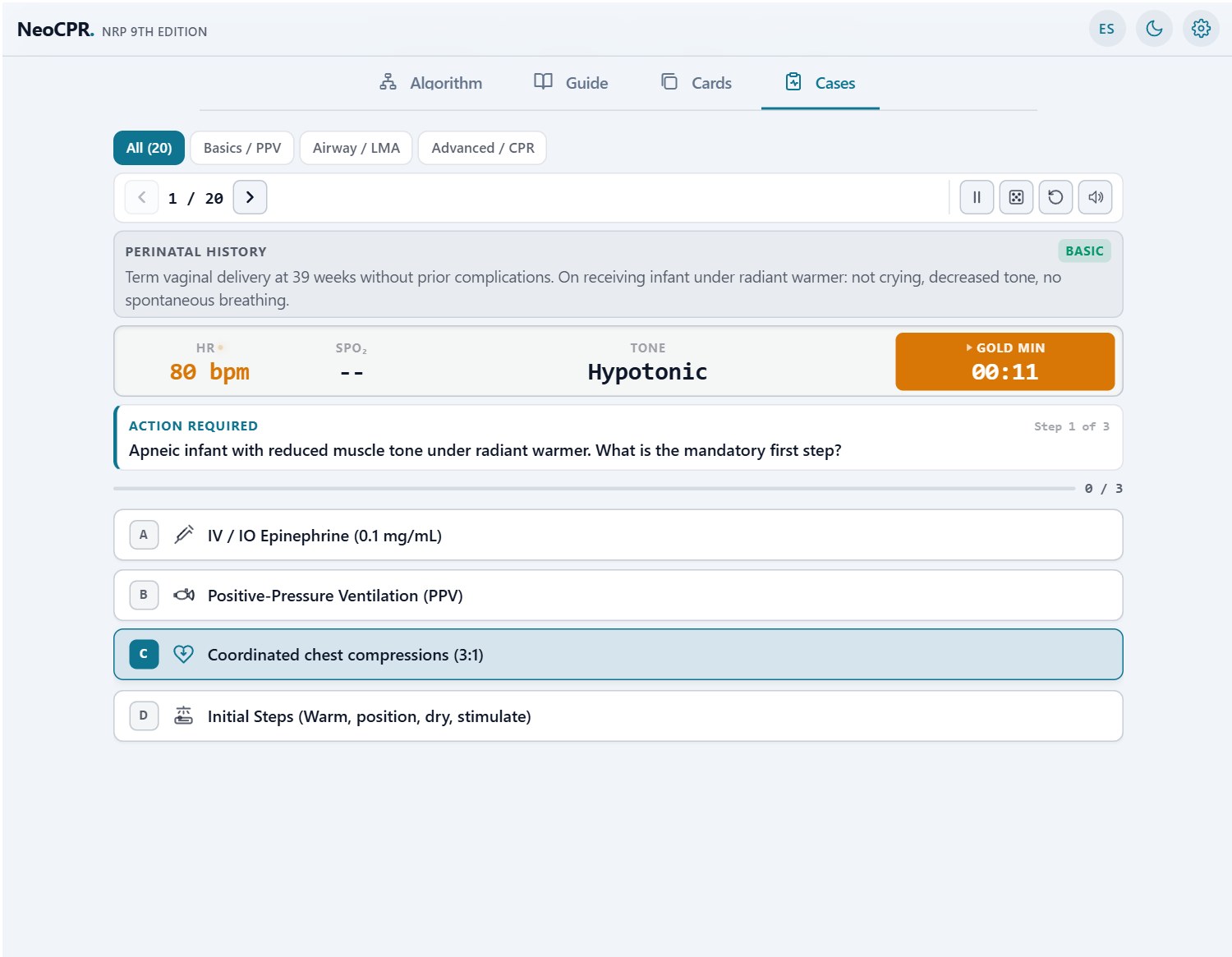
Want a timer and a live monitor? NeoCPR's cases show a vitals monitor and a Golden Minute timer while you choose each action. The free demo lets you run the first 6 of the 20 cases without an account.
Run a case in the demoQuestions about NRP practice cases
What are NRP practice cases?
How many practice cases are free?
How do I practice NRP cases without a manikin?
What is the Golden Minute in NRP?
Do practice cases replace the hands-on skills session?
This page summarizes the NRP 9th Edition textbook for study. It does not replace your NRP course or your hospital's protocols. PediaSuite is independent and is not affiliated with the AAP or AHA.
Keep studying
NRP algorithm walkthrough
The whole 9th Edition path, from the pre-birth questions to epinephrine, with the number behind each step.
Read the walkthrough →NRP study guide
What each of Lessons 1 to 11 covers, plus one table of the numbers worth memorizing.
Open the study guide →NRP flashcards
Twenty sample cards written from the textbook, with the lesson listed under each answer.
Try the cards →NRP practice questions
Scenario-based exam questions with tutor and timed exam modes.
Take the practice exam →Run a practice case in the free demo.
It is the real NeoCPR app with some content locked. No account or credit card. The full module is a one-time $29 with no subscription.
References
- American Academy of Pediatrics, American Heart Association. Textbook of Neonatal Resuscitation. 9th ed. Itasca, IL: American Academy of Pediatrics; 2025. Lesson 3: Initial Steps of Newborn Care; Lesson 4: Ventilation; Lesson 5: Endotracheal Intubation; Lesson 6: Chest Compressions; Lesson 7: Medications; Lesson 8: Resuscitation and Stabilization of Preterm Infants; Lesson 9: Post-Resuscitation Care; Lesson 10: Special Considerations.
- Lee HC, Strand ML, Finan E, et al. Part 5: Neonatal Resuscitation: 2025 American Heart Association and American Academy of Pediatrics Guidelines for Cardiopulmonary Resuscitation and Emergency Cardiovascular Care. Circulation. 2025;152(16 Suppl 2):S385–S423. doi:10.1161/CIR.0000000000001367